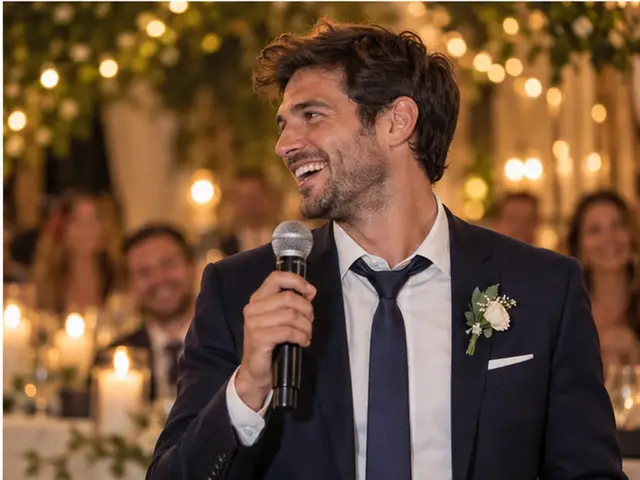
How to write a wedding speech by watching one get written
No rules list. We're going to write Mark's speech for his daughter's wedding, start to finish. The same steps work for a mother, a sibling, a grandparent or a friend.

Step 1 of 6
Pick one story, not her whole life
Mark's first draft was Lily's life in order: born, first steps, first day of school, prom, graduation, the engagement. Nine minutes, and nothing anyone would remember. If you're a mother, a sibling, a grandparent or a friend, the same six steps apply to you. Only step 2 is just for hosts.
Your turn: call keep or cut on each one, then see what Mark did.
- The day she was born
- Her first steps
- Everything she's achieved since school
- The letters she wrote the tooth fairy
- The time she backed my car into the mailbox
- Her first boyfriend
For your speech
Pick the one story only you could tell. Her whole life is what you leave out.
Mark
I had twenty-nine years in there. It turns out a room will listen to one afternoon longer than it will listen to a whole life.
Step 2 of 6
Welcome the room like a host
The father of the bride usually speaks first, and he speaks for the hosts. So before any story, the room needs a welcome and a thank-you. Mark's first thank-you list had twenty names. If you aren't hosting, skip to step 3.
The long list
Before I begin, I'd like to thank the caterers, the florist, the band, Father Michael, Aunt Ruth for the flowers, Carol's sister for the seating chart, our neighbors the Hendersons, everyone who drove in from Ohio…
Three names
Good evening, everyone. I'm Mark, Lily's dad, and Carol and I are so glad you're all here. David and Anne, thank you for sharing this day with us, and for Owen.
For your speech
Welcome the room, thank the other family, and stop at three names.
Why it works for Mark
Three names, and two of them belong to the other family. The vendors get thanked in person and paid. The room came to hear about Lily, and every name on a list is another minute before she comes up. Thanking Owen's parents first tells the room that two families are hosting this together.
Mark
Carol read my list and asked if I was accepting an award. I cut it to three names that night.
Quick check
Which one would Mark keep?
Pick an answer to see why.
Mark’s draft so far
0:17 of 2:15 spoken
Good evening, everyone. I'm Mark, Lily's dad, and Carol and I are so glad you're all here.
David and Anne, thank you for sharing this day with us, and for Owen.
Step 3 of 6
Tell the story in under a minute
A parent remembers every detail, which is exactly why a parent's story runs long. Keep the whole speech under five minutes, timed out loud. Mark's runs 2:15. Most of his cutting happened here.
The whole memory
So when Lily was about seven she lost her first molar, or maybe it was the second one, and we'd been giving a dollar a tooth, which Carol thought was too much, and then Lily found out her friend Madison got five dollars, so she was very upset about that, and she wrote this whole letter, because she was always writing letters…
What made the speech
When Lily was seven, she lost a molar and left the tooth fairy a letter. “One dollar is not enough for a molar. I am asking for three.” Signed, in full. The tooth fairy, who needed an answer by morning, wrote back in very small handwriting: “Two. Final offer.” The next night there was another note on her pillow. It said: “Deal.” I still have both of her letters.
For your speech
Keep the scene, one detail, and the point. Let the room work out the rest.
Why it works for Mark
The whole negotiation fits in three notes, and the room hears all three. Madison, the five dollars and what Carol thought are gone, because they explain the letter instead of letting it speak. “Signed, in full” is the one detail that shows a seven-year-old taking herself seriously. And “the tooth fairy, who needed an answer by morning” lets the room work out who the tooth fairy was without Mark saying it.
Mark
I kept adding “I was the tooth fairy, of course.” Every time I cut it, the laugh came one sentence earlier.
Mark’s draft so far
1:00 of 2:15 spoken
Good evening, everyone. I'm Mark, Lily's dad, and Carol and I are so glad you're all here.
David and Anne, thank you for sharing this day with us, and for Owen.
When Lily was seven, she lost a molar and left the tooth fairy a letter. “One dollar is not enough for a molar. I am asking for three.” Signed, in full.
The tooth fairy, who needed an answer by morning, wrote back in very small handwriting: “Two. Final offer.” The next night there was another note on her pillow. It said: “Deal.”
I still have both of her letters.
Step 4 of 6
Be proud without reading her résumé
This is where a proud parent reads out her résumé: the degree, the job, the promotion. The room claps politely and learns nothing about her. Mark turns the letters into one sentence about who Lily is.
The résumé
Lily graduated top of her class, went to law school on a scholarship, and at twenty-nine she's already running her own cases. We could not be prouder of everything she has achieved.
One thing she is
That's Lily. She has always known what something is worth, and she asks for it, politely, in writing. And when the answer is fair, she says yes and means it.
For your speech
Say one thing she is, not everything she's done.
Why it works for Mark
The letters already showed the room who Lily is, so one sentence can name it. Asking for three, taking two and saying “Deal” is that sentence, acted out when she was seven. Anyone who knows she's a lawyer makes the connection without being told. And “when the answer is fair, she says yes” sets up the next step, because the next person she said yes to is Owen.
Mark
Carol said, “She knows her own résumé.” That was the whole edit.
Quick check
Which one would Mark keep?
Pick an answer to see why.
Mark’s draft so far
1:16 of 2:15 spoken
Good evening, everyone. I'm Mark, Lily's dad, and Carol and I are so glad you're all here.
David and Anne, thank you for sharing this day with us, and for Owen.
When Lily was seven, she lost a molar and left the tooth fairy a letter. “One dollar is not enough for a molar. I am asking for three.” Signed, in full.
The tooth fairy, who needed an answer by morning, wrote back in very small handwriting: “Two. Final offer.” The next night there was another note on her pillow. It said: “Deal.”
I still have both of her letters.
That's Lily. She has always known what something is worth, and she asks for it, politely, in writing. And when the answer is fair, she says yes and means it.
Step 5 of 6
Welcome Owen by name
The line parents most often forget is the one the new spouse remembers. The usual version is a quick “welcome to the family” on the way to the toast. Mark gives Owen his own moment, and it's something he saw.
The usual line
And of course, Owen, welcome to the family. We're very happy to have you.
Something he saw
Owen, the first time you came to dinner, Lily told us you'd bring dessert. You brought two, because you couldn't decide, and you asked which one we'd rather have. I watched my daughter, who has never taken the first offer in her life, say “Both.” And you said, “Deal.” Owen, welcome. You've been family since the second dessert.
For your speech
Say his name, tell one thing you saw him do, and welcome him in so many words.
Why it works for Mark
Owen gets his name, a scene and a welcome, and the scene is the tooth fairy story again. Lily asks for more, and this time the person across the table says yes without haggling. Nobody has to say they're a good match. The room hears “Deal” for the second time and does the math.
Mark
My first version thanked him for “taking good care of her.” She'd have hated that. She takes care of herself.
Mark’s draft so far
1:50 of 2:15 spoken
Good evening, everyone. I'm Mark, Lily's dad, and Carol and I are so glad you're all here.
David and Anne, thank you for sharing this day with us, and for Owen.
When Lily was seven, she lost a molar and left the tooth fairy a letter. “One dollar is not enough for a molar. I am asking for three.” Signed, in full.
The tooth fairy, who needed an answer by morning, wrote back in very small handwriting: “Two. Final offer.” The next night there was another note on her pillow. It said: “Deal.”
I still have both of her letters.
That's Lily. She has always known what something is worth, and she asks for it, politely, in writing. And when the answer is fair, she says yes and means it.
Owen, the first time you came to dinner, Lily told us you'd bring dessert. You brought two, because you couldn't decide, and you asked which one we'd rather have. I watched my daughter, who has never taken the first offer in her life, say “Both.” And you said, “Deal.”
Owen, welcome. You've been family since the second dessert.
Step 6 of 6
Remember who's missing, then raise a glass
Weddings bring up the people who aren't there. Say it once, in one sentence, and turn back to the couple. The last thing the room hears should be the toast.
The tribute
Before I finish, I need to say a few words about Lily's grandmother, Rose, who we lost two years ago. Rose was the heart of this family. She taught Lily to bake, she never missed a school play, she…
One sentence, then the toast
Lily's grandma Rose would have loved today, and she'd have told Owen to bring three desserts. So, everyone, please raise your glasses. To Lily, who always knew what she was worth. And to Owen, who never once asked her to take less.
For your speech
Name who's missing in one sentence. End on the couple and on your story.
Why it works for Mark
Rose gets one sentence, and it ends on a smile, so the room goes into the toast lifted instead of in tears. A tribute that runs a minute turns a wedding speech into a eulogy. Then the toast brings the letters back one last time: she knew her worth at seven, and Owen is the one who never argued the price.
Mark
I read the Rose line out loud every night for a week. By the wedding I could get through it. Just.

Mark’s speech, start to finish
Every line from the six steps, in one piece. This is what he read at the wedding.
Mark’s Speech
Spoken time 2:15
Good evening, everyone. I'm Mark, Lily's dad, and Carol and I are so glad you're all here.
David and Anne, thank you for sharing this day with us, and for Owen.
When Lily was seven, she lost a molar and left the tooth fairy a letter. “One dollar is not enough for a molar. I am asking for three.” Signed, in full. laugh
The tooth fairy, who needed an answer by morning, wrote back in very small handwriting: “Two. Final offer.” The next night there was another note on her pillow. It said: “Deal.” laugh
pause I still have both of her letters.
That's Lily. She has always known what something is worth, and she asks for it, politely, in writing. And when the answer is fair, she says yes and means it.
look up Owen, the first time you came to dinner, Lily told us you'd bring dessert. You brought two, because you couldn't decide, and you asked which one we'd rather have. I watched my daughter, who has never taken the first offer in her life, say “Both.” And you said, “Deal.” laugh
Owen, welcome. You've been family since the second dessert.
Lily's grandma Rose would have loved today, and she'd have told Owen to bring three desserts.
glasses up So, everyone, please raise your glasses. To Lily, who always knew what she was worth. And to Owen, who never once asked her to take less.
Four things Mark cut on purpose
Check your draft for these four. Next to each one is what he did instead.
Cut this: The baby-to-now montage
“The day she was born, I knew…”
Instead: Pick one afternoon and tell it properly.
“When Lily was seven, she lost a molar…”
Cut this: The thank-you roll call
“…the florist, the band, Aunt Ruth for the flowers…”
Instead: Thank the other family, then stop.
“David and Anne, thank you for sharing this day with us, and for Owen.”
Cut this: “Giving her away” and money jokes
“Owen, she's all yours. No refunds.”
Instead: Welcome him in instead of handing her over.
“Owen, welcome. You've been family since the second dessert.”
Cut this: Marriage jokes from the internet
“Here's to the old ball and chain…”
Instead: Use a line only your family would recognize.
“Two. Final offer.”
On the day: what Mark did at the mic
Writing it is half the job. Here is the other half.
Don't: Printing it at normal size
Instead: Big type, glasses in your pocket.
Print the cards at 16 point or larger and check the light where you'll stand. Put your reading glasses in your jacket before dinner, not in the car.
Don't: Letting the mic sink to your chest
Instead: Keep the mic at your chin.
Hold it a couple of inches from your mouth. It drifts down when you read, so check it every time you turn a card.
Don't: A drink to steady the nerves
Instead: Eat first. One glass.
Eat before you speak, even if the speeches come before dinner. One glass steadies you. The second one loosens the timing.
Don't: Apologizing when your voice goes
“Sorry, sorry, I told myself I wouldn't do this.”
Instead: Handkerchief in your pocket. Pause.
pauseThe room expects a father to choke up, and it's on your side. Stop, breathe, and pick up at the next line.
Don't: Not knowing when you're on
Instead: Ask the planner when you speak.
Hosts usually go first, then the best man and the maid of honor, and the couple sometimes closes. Find out who introduces you and who speaks after you, so you can hand the microphone over instead of wandering off with it.
Mark's speech took four weeks. Yours takes three minutes.
The writer asks which speech you're giving, for one story only you could tell, and what you wish for the two of them, then drafts the speech for you. Free.
Write my speech